



Table Of Contents

Can Someone Track You with Your Phone Number?
Your phone number is more than a way to receive calls. It is tied to your carrier account, linked to apps that log your location, and in some cases, enough for a third party to pinpoint where you are right now. The short answer is yes — someone can track a phone number, and they do not always need a warrant or special equipment to do it.
If you have wondered whether your number is exposing your location, or whether you can track phone number locations yourself, this guide covers both sides: the methods used, who can use them, and exactly what you can do about it.
Can Your Phone Number Actually Reveal Your Location?

A phone number does not broadcast GPS coordinates by itself. It is not a live beacon. But it is a unique identifier tied to a SIM card, and that SIM card is constantly communicating with nearby cell towers. Anyone with access to that carrier data — or to the protocols that govern how towers exchange information — can use your number to request location data.
The level of precision varies by method. Cell tower data gives a rough geographic radius. GPS-level accuracy requires either software on the device or user interaction. But “rough” still means your neighborhood, your city block, or your commute route. For most threat scenarios, that is precise enough to matter.
6 Ways Someone Can Track a Phone Number
Understanding how phone number tracking works means understanding the specific methods. Some require technical access. Others only need you to tap a link. Here are the six most common approaches.
Cell Tower Triangulation
Every phone constantly connects to nearby cell towers to maintain a signal. Carriers log which towers your device pings, at what time, and with what signal strength. By comparing the signal from three or more towers, carriers can calculate your approximate location — typically within 100 meters in dense urban areas and up to several kilometers in rural regions.
This data is available to carriers at all times. Law enforcement can request it with a court order. In 2018, the Supreme Court ruled in Carpenter v. United States that accessing historical cell tower records requires a warrant. Real-time requests in emergencies, however, can sometimes bypass this requirement under exigent circumstances.
SS7 Network Exploit
SS7 (Signaling System No. 7) is the protocol that allows mobile networks worldwide to communicate — routing calls, confirming roaming, and exchanging subscriber data. It was designed in 1975 with no built-in authentication, and that vulnerability has never been fully patched.
A hacker with access to the SS7 network can send a location request to any carrier in the world using only your phone number. The carrier’s network responds with your approximate location — no interaction from you required, no app needed, and no visible sign on your device. This method has been used by state intelligence agencies, telecom insiders, and organized cybercrime groups. It is largely inaccessible to the average person, but it represents the most alarming end of what phone number tracking can enable.
Spyware and Stalkerware
Spyware is software installed on a device that silently reports location, messages, and app activity to a remote party. The most common delivery method is a phishing link sent via SMS or messaging apps. A convincing message — a fake delivery notification, a spoofed bank alert — gets the target to tap a link, which downloads malware to the device.
Once installed, stalkerware apps transmit real-time GPS location continuously. Products like Pegasus, used against journalists and activists in multiple countries, demonstrate how powerful this class of software is. Consumer-grade versions are sold openly online under the guise of parental monitoring. The common thread: the target rarely knows the software is there.
If your number is used to send you a phishing link that installs spyware, phone number location tracking without knowing it is happening becomes a real outcome.
Tracking Apps and Link-Based Location Requests
A growing category of tools handles location tracking differently: they ask. Instead of exploiting a vulnerability, these services generate a tracking link that the user sends via any messaging platform. When the recipient taps the link, the service captures GPS coordinates and returns them to the requester.
This is how Scannero’s “Location by Link” feature works. When someone needs to track location by phone number without installing anything on the target device — finding a family member in a crowded area, confirming a child arrived safely, locating a lost phone — Scannero sends a consent-based location request via SMS. The recipient taps, the location is confirmed, and the result appears on a map in the requester’s dashboard in under two minutes. No app download is needed on either device.
This method is legal precisely because it requires the recipient’s action. It sits at the opposite end of the spectrum from SS7 exploits and spyware — transparent, fast, and designed for legitimate use.
IP Address Lookup
Your phone number is linked to accounts that transmit your IP address during normal use — messaging apps, social platforms, and email services among them. Knowing your IP address gives a general location: city, ISP, and sometimes postal area. This is not GPS-level accuracy, but it is used regularly by data brokers and advertisers to build location profiles over time.
IP-based tracking is passive and hard to detect. It does not require any direct access to your phone number beyond knowing it is associated with a specific account.
SIM Swap Attack
A SIM swap is a social engineering attack in which someone convinces your mobile carrier that they are you. Armed with basic personal information gathered from data breaches or social media, the attacker calls your carrier’s customer support and requests that your number be transferred to a new SIM card they control.
Once the swap is complete, all calls and texts — including two-factor authentication codes and password reset messages — route to the attacker’s device instead of yours. The FBI documented 1,611 SIM swap complaints in 2021, with victims collectively losing $68 million. While this does not give the attacker your GPS location directly, it hands them the keys to every account linked to your number, many of which contain location data.
Who Has the Ability to Track Your Phone Number?
- Mobile carriers — always, by default, via tower connection logs
- Law enforcement — with a court order or under exigent circumstances
- Hackers with SS7 access — anyone who has paid for or exploited access to telecom infrastructure
- Stalkers and abusive partners — via consumer spyware installed through physical access or a phishing link
- Data brokers and advertisers — via IP address and app permission aggregation
- Anyone you share a link with — if they use a link-based tracking service like Scannero, and you tap the link
Is It Legal to Track Someone by Phone Number?
In the United States, tracking another person’s phone without their knowledge or consent is illegal under multiple federal and state statutes, including the Electronic Communications Privacy Act. Mobile carriers are prohibited from sharing your location data with private parties without consent or a valid legal order.
Law enforcement can track a phone number, but generally requires a warrant. The Supreme Court’s Carpenter decision reinforced this standard for historical data. Real-time emergency tracking is permitted in limited circumstances involving immediate threats.
Consent-based tracking is legal because the target actively participates. If someone taps a location link and their coordinates are shared, that interaction constitutes consent. Tools built on this model — including Scannero — operate within the legal framework that governs location data in the US and most other jurisdictions.
How to Use Scannero to Track a Phone Number
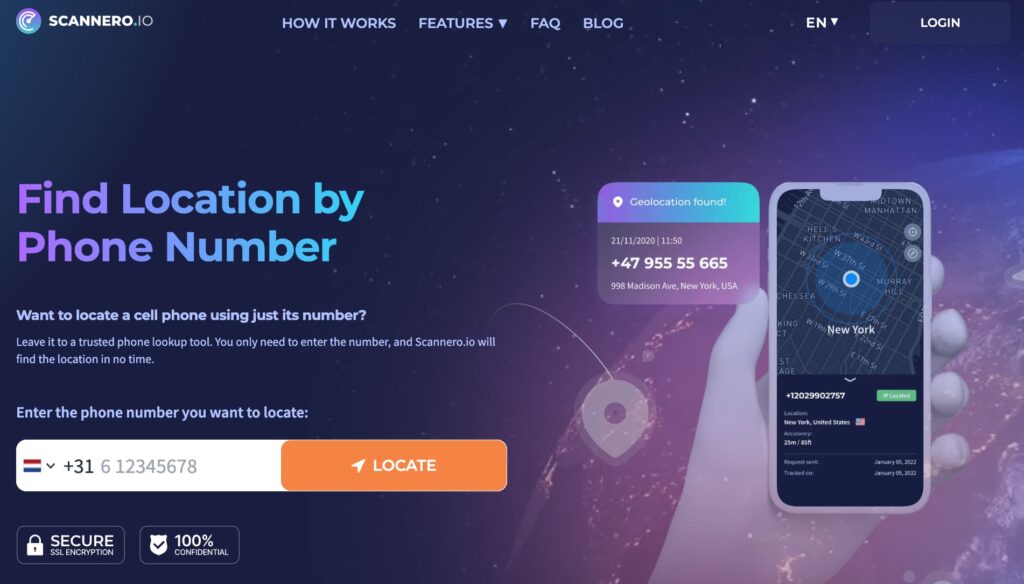
Scannero uses GPS and cellular tower data to determine a device’s current position, accessed through a consent-based request system. It works from any browser, requires no installation on the target device, and supports all carriers and phone types worldwide.
Two methods are available:
- Location by Number — Enter the phone number. Scannero sends an automated request to that number. The recipient taps to confirm. Location is returned to your dashboard.
- Location by Link — Generate a tracking link inside your account. Send it through any messaging app, SMS, or email. When the recipient taps it, their GPS coordinates are pinned on a map.
Here is how to get started:
- Create an account at scannero.com
- Enter the target phone number or choose “Location by Link”
- Send the location request (either automatically via Scannero or manually through your preferred messenger)
- The recipient receives the request and taps to allow
- Location data appears on your dashboard map, typically within 1–2 minutes
Common use cases include parents confirming a teenager’s location, recovering a lost or stolen phone, or coordinating with a family member in an unfamiliar city. Because no app is required on the recipient’s device, it works even on basic smartphones.
Scannero vs. Other Phone Tracking Options
When evaluating a phone number tracker for family safety or personal use, these criteria matter most.
| Feature | Scannero | Clario Anti Spy | Life360 | GEOfinder |
|---|---|---|---|---|
| Track by phone number (no app on target) | Yes | No | No | Yes |
| Works on any carrier worldwide | Yes | No | Limited | Limited |
| No installation required on target device | Yes | No | No | No |
| Consent-based (legal in US) | Yes | Yes | Yes | Partial |
| Reverse phone number lookup | Yes | No | No | No |
| Data breach / leak check | Yes | Yes | No | No |
| Works on older phones without smartphones | Yes | No | No | No |
| Monthly subscription available | Yes | Yes | Yes | Yes |
For users who need to track a cell phone location by number without installing any software, Scannero is the only option in this comparison that combines no-install operation with cross-carrier compatibility and worldwide coverage. Life360 and Clario require app installation on both devices and are designed for ongoing family monitoring rather than one-time location confirmation.
Signs Your Phone Number Is Being Tracked
These patterns can indicate that someone has installed spyware or is monitoring your device through your number.
- Faster-than-normal battery drain — Spyware runs continuously in the background, consuming power even when you are not actively using the phone
- Unexpectedly high data usage — Tracking software transmits location and activity data to remote servers; check your data usage history for unusual spikes
- Unfamiliar apps appearing on your home screen — Some spyware installs alongside a disguised app; review installed apps for anything you do not recognize
- Phone warm when idle — A device that feels warm when the screen is off is likely running background processes
- Receiving suspicious links by SMS — Phishing links are the most common delivery method for spyware; an increase in unusual texts from unknown numbers is worth noting
None of these signals confirm tracking on their own. But two or more occurring together, especially after a relationship conflict or after losing temporary physical access to your phone, warrants a closer look.
How to Stop Someone from Tracking Your Phone Number
These steps reduce your exposure across the main attack vectors.
- Add a SIM PIN to your carrier account — A SIM lock prevents unauthorized SIM swaps. Call your carrier or set it through your account portal. Most major US carriers support this feature.
- Switch from SMS-based 2FA to an authenticator app — Google Authenticator, Authy, or hardware keys remove your phone number from the authentication chain. A SIM swapper gets nothing if 2FA does not go through SMS.
- Audit location permissions on all apps — Go to Settings > Privacy > Location Services (iOS) or Settings > Apps > Permissions > Location (Android). Revoke access for any app that does not need it to function.
- Scan your device for unfamiliar apps — Review your full installed app list, not just your home screen. Delete anything you do not recognize.
- Use a VPN on public Wi-Fi — Public networks expose your IP address and allow man-in-the-middle attacks. A VPN encrypts your connection and masks your actual IP.
- Never tap SMS links from unknown senders — Spyware delivery almost always starts with a link. When in doubt, delete the message without opening it.
- Check for call forwarding rules — Dial *#21# on most phones to see if calls are being forwarded to another number. Dial ##21# to cancel any active forwarding.
Frequently Asked Questions
Can someone track my location with just my phone number?
Yes, with limitations. Cell tower data gives an approximate location radius. SS7 exploits can return more precise location data. Spyware requires device interaction first. None of these methods give GPS-level precision in real time unless software is installed on the device or the target taps a tracking link.
Can law enforcement track a phone number without a warrant?
Generally no — the Carpenter v. United States Supreme Court ruling (2018) established that accessing historical cell tower location records requires a warrant. Exceptions exist for genuine emergencies involving immediate threats to life, known as exigent circumstances.
What should I do if I think someone is tracking my phone?
Check for unfamiliar apps, review location permissions, audit call forwarding rules (dial *#21#), and add a SIM PIN to your carrier account. If you suspect stalkerware, a factory reset is the most reliable way to remove it — back up your data first.
How accurate is phone number location tracking?
Cell tower triangulation: 100 meters in dense cities, up to several kilometers in rural areas. GPS via spyware or consent-based apps: accurate to within a few meters. IP-based tracking: city-level only. The accuracy of any method depends on what data it can access.
Take Control of Your Phone’s Location Privacy
Your phone number is a thread that connects to your location, your accounts, and your personal information. The six methods covered here — from cell tower triangulation to SS7 exploits — show that this thread can be pulled by actors ranging from your own mobile carrier to sophisticated cybercriminals. The gap between “theoretical risk” and “active threat” is smaller than most people assume.
Protecting yourself starts with the steps above: SIM PIN, app-based 2FA, location permission audits, and staying alert to signs of compromise.
If you are on the other side of this — you need to track a phone number legally, find a lost device, or confirm a family member’s location — Scannero handles it without requiring any app on the target device. Enter the number, send the request, and the location appears on your dashboard map within minutes. No installation. No technical knowledge required. Just a straightforward answer to where someone is.

Related posts
 May 25, 2026
 May 25, 2026
 May 25, 2026





