


Table Of Contents

Celltrack Review: Is This Credit-Based Phone Tracker Worth Buying?
Celltrack is a web-based phone tracking service that lets you locate a device using its phone number — without installing anything on the target phone or your own. If you’ve seen it advertised, considered buying credits, or want to know whether it delivers what it promises, this review covers the important details.
Unlike most trackers, Celltrack doesn’t charge a monthly subscription. Instead, you buy credits and spend them per service. That model sounds appealing — but the credits are consumed before results are returned, and the results aren’t guaranteed. This article covers how each Celltrack service works, what the credit packages cost, how accurate results are in practice, what real users report, and a direct comparison with Scannero.
What Is Celltrack?
Celltrack is a web-based phone tracking service available at celltrack.eu. It’s GDPR-compliant and requires no app installation on either your device or the device you want to track. The platform offers several services — telecom tracking, WhatsApp lookup, social media search, anonymous SMS, and lost phone finding — each of which draws from Celltrack’s credit balance when used.
The core tracking method requires the target’s participation. When you submit a number for telecom tracking, Celltrack sends a permission request to that number via SMS. The target must click and accept before any location data is returned. This is the fundamental operational constraint — and the one most users discover after purchasing credits.
Celltrack’s Services: What Each One Does

Celltrack groups its features into five distinct services:
- Telecom tracking — locates a phone by its number using cell tower triangulation; requires the target to accept a permission request via SMS. Results range from precise GPS to country/city level only, depending on signal quality and network coverage. Costs 1 credit per use.
- WhatsApp lookup — checks whether a phone number has an active WhatsApp account and can view the number’s WhatsApp Status anonymously, without adding the number to your contacts. Useful for verifying whether someone has the app.
- Social media search — attempts to link a phone number to associated social media profiles. Works only if the target has connected their phone number to their profile settings. No result is returned if they haven’t.
- Anonymous SMS — sends a text message to any number without revealing your identity. The recipient sees a generic or anonymous sender ID, not your actual number. Costs credits per send.
- Lost phone finder — designed to help locate your own device. Sends a tracking ping to the registered number and returns the last known location.
All services are accessed via the Celltrack website browser — no downloads or installations needed.
How Celltrack Works: Step by Step
The core service — telecom tracking — follows five steps:
- Visit celltrack.eu and enter the phone number you want to locate
- Celltrack displays basic information for free: the carrier and the country associated with the number
- To proceed to full tracking, create an account and purchase a credit package
- Celltrack sends a permission request to the target’s phone — the target must click to accept
- If the target accepts, a tracking result appears on your dashboard with location details, accuracy rating, and network information
Critical note: your credits are debited when the tracking request is sent — not when a successful result is returned. If the target ignores the request or if the signal quality is too low for a precise result, you lose the credit regardless. Celltrack rates each result as “High,” “Medium,” or “Low” accuracy — low accuracy results typically show only the country and approximate city, not GPS coordinates.
Celltrack Pricing: Credits vs. What You Actually Get
Celltrack uses a credit-based model with no subscription. You purchase a package and spend credits per service use.
| Package | Price | Credits | Cost Per Telecom Track |
|---|---|---|---|
| Starter | $20 | 10 credits | $2.00 per use |
| Standard | $25 | 15 credits | $1.67 per use |
| Value | $30 | 30 credits | $1.00 per use |
The pay-per-use structure is more flexible than a monthly subscription for occasional searches. The important caveat: credits are consumed before results are confirmed. A failed search — because the target didn’t respond or because accuracy was too low — still costs the credit. Users who expected a refund for unproductive searches have reported receiving none.
How Accurate Is Celltrack?
Accuracy is the most significant variable in the Celltrack experience. The platform itself acknowledges this by displaying an accuracy rating — “High,” “Medium,” or “Low” — for each result.
In independent testing by Detectico, some phone numbers returned only approximate location data: the country and a general city, without GPS-level precision. Accuracy depends on how many cell towers are in the target device’s area and the quality of the number’s network provider. Urban areas with dense cell tower coverage tend to produce better results than rural or low-signal areas.
The more significant concern from real user reports is the anonymity failure. Celltrack markets its tracking as anonymous — the person being tracked shouldn’t know who sent the request. However, multiple users on PissedConsumer and Trustpilot report that Celltrack’s own domain name appeared on the target’s device when the permission request was delivered. In at least one case, the sender was identified despite expecting anonymity. The product functions, but the anonymity claim should not be relied upon completely.
Celltrack Pros and Cons
| Pros | Cons |
|---|---|
| No subscription — pay per use, no recurring charge | Credits consumed even if tracking fails or accuracy is low |
| No app installation on target device | Target must accept the permission request — no acceptance = no location |
| GDPR-compliant operation | “Anonymous” tracking not always anonymous — Celltrack domain seen by target in some cases |
| Multiple service types: location, WhatsApp, social, SMS | Accuracy rated “High” to “Low” — low results common for some numbers |
| Basic carrier/country info shown before credits are spent | Limited customer support — difficulty reaching company for refunds |
| Works for all carriers and countries | Server availability issues reported |
| WhatsApp Status viewing without adding the contact | No subscription option for frequent users — credits add up quickly |
What Users Are Saying About Celltrack
Celltrack has 267 reviews on Trustpilot. The split follows a familiar pattern in tracking tools: positive reviews typically describe smooth, quick results for numbers in good signal areas; negative reviews center on credits lost to failed or approximate searches.
Recurring complaints across Trustpilot and PissedConsumer: users who paid €20 or more in credits and received only country/carrier information — not the precise location they were expecting. One user on PissedConsumer reported a $49.95 charge with no way to access their account or speak with anyone. Another reported Celltrack’s domain appearing on the target’s phone during a supposedly anonymous tracking attempt, causing an unintended confrontation.
Scam Detector’s automated analysis flagged celltrack.eu with a low trust score of 23.4 out of 100, citing indicators of phishing and spam risk. This doesn’t mean the service is fraudulent — it operates legally under GDPR — but the automated rating reflects the pattern of user complaints around unexpected outcomes and billing friction.
Who Is Celltrack Best For — and Where It Falls Short
The credit model makes Celltrack a reasonable choice for genuinely occasional use: verifying if a number has WhatsApp, looking up whether a number is linked to a social media account, or sending an anonymous text. For those one-off tasks, spending $1–$2 per credit is proportionate.
Celltrack becomes less cost-effective when used for location tracking specifically. The permission requirement means results can’t be guaranteed, and the accuracy variable means that even when the target accepts, the result may be “Low” — returning only a country or city. For anyone in an urgent situation, or one where the tracking result needs to be precise and reliable, that uncertainty is a meaningful drawback.
Celltrack vs. Scannero: A Direct Comparison
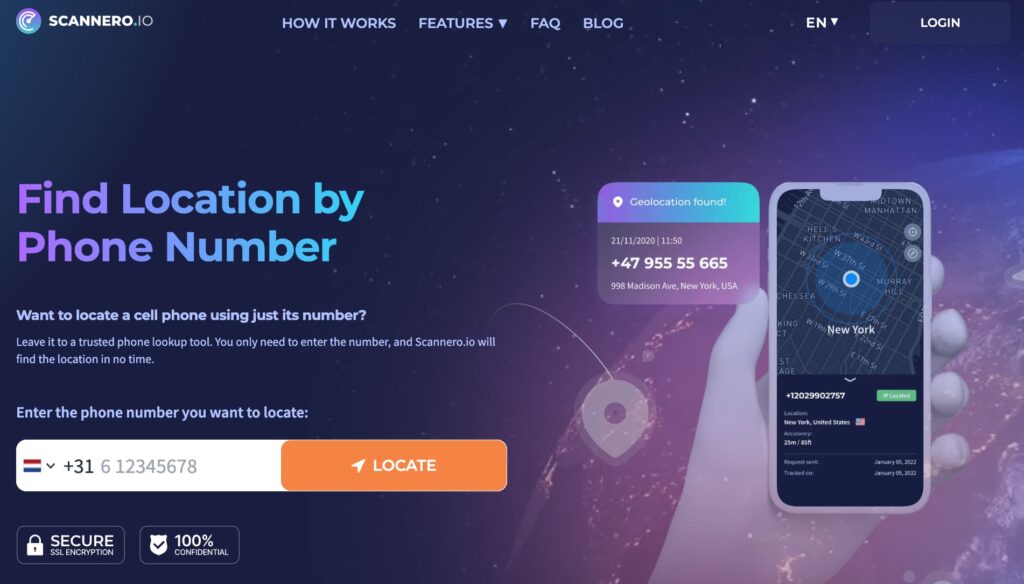
For users who need a location result they can count on — not a credit that might return “Low accuracy” — the difference between Celltrack and Scannero becomes clear when you look at how each tool handles the result uncertainty.
Both tools require the target to take an action (click a link or accept a request). Scannero’s advantage is in what happens around that action: the tracking link can be sent via any channel — WhatsApp, email, iMessage, SMS — rather than a permission request from an unfamiliar domain. This makes it easier to send in a context the recipient will open. Scannero also includes reverse phone lookup and username search capabilities that Celltrack doesn’t offer.
| Feature / Criteria | Scannero | Celltrack |
|---|---|---|
| Pricing model | Subscription per session | Credits per use |
| Requires target action | Yes — link click | Yes — permission acceptance |
| Accuracy guarantee | GPS-level when link clicked | High to Low — variable |
| Link delivery method | Any channel (SMS, WhatsApp, email) | Own permission request system |
| Anonymous tracking | Yes | Partial — domain may be visible to target |
| No app install on target | Yes | Yes |
| Works globally | Yes | Yes |
| Reverse phone lookup | Yes | No |
| Support accessibility | Standard subscription support | Limited; complaints of unresponsiveness |
Key Differences
The most meaningful difference is accuracy certainty. When Scannero’s link is clicked, GPS-level location data is returned — the result is precise. Celltrack’s result depends on signal quality and cell tower density, which the user can’t control, and the credit is consumed regardless.
The second difference is delivery flexibility. Scannero lets you send the tracking link through any messaging app the recipient actually uses — WhatsApp, iMessage, email — in a context that doesn’t trigger suspicion. Celltrack sends its own permission request from its domain, which both alerts the recipient and, in some reported cases, reveals the Celltrack platform to them.
For users who need a quick, precise location from a phone number — without the uncertainty of whether credits will produce a usable result — Scannero is worth comparing directly before committing to a credit purchase.
Frequently Asked Questions
Is Celltrack legit?
Celltrack is a real service that operates legally under GDPR compliance. It is not a scam in the sense that it delivers a service. However, accuracy varies significantly, credits are consumed whether or not results are useful, and multiple users report unexpected charges and difficulty accessing support. The platform is legitimate; the results are not guaranteed.
What happens to my credits if the tracking fails?
Credits are consumed when the tracking request is sent — not when a successful result is confirmed. If the target doesn’t accept the permission request, or if the location result comes back as “Low” accuracy, the credit is still spent. Celltrack’s policy does not include automatic refunds for failed or low-quality searches.
Is Celltrack free?
Basic carrier and country information is shown for free before any payment. Accessing full tracking results requires purchasing credits. The minimum credit package is $20 for 10 credits, which equals $2.00 per telecom tracking use. There is no subscription plan or free trial.
Verdict: Is Celltrack Worth Buying?
Celltrack is a functional, legally compliant service with a genuinely flexible pricing model. For occasional lookups — checking if a number has WhatsApp, doing a social media search, or sending an anonymous SMS — the credit-based approach is reasonable, and basic carrier information is available without spending anything.
For location tracking specifically, the limitations matter. Accuracy is variable, credits are spent before results are confirmed, and the target must actively accept the request. In urgent or high-stakes situations, that combination of uncertainty is a real constraint.
Where Celltrack falls short — guaranteed accuracy and flexible link delivery — is where Scannero is structured differently. Scannero returns GPS-level precision when the link is clicked and lets you send it through any channel the recipient is most likely to open. For users whose priority is reliable location data rather than a menu of credit-based services, it’s a more predictable starting point.

Related posts
 May 25, 2026
 May 25, 2026
 May 25, 2026





